
The Expert insights on Foot-and-Mouth Disease, market trends, and technical strategies across Asia
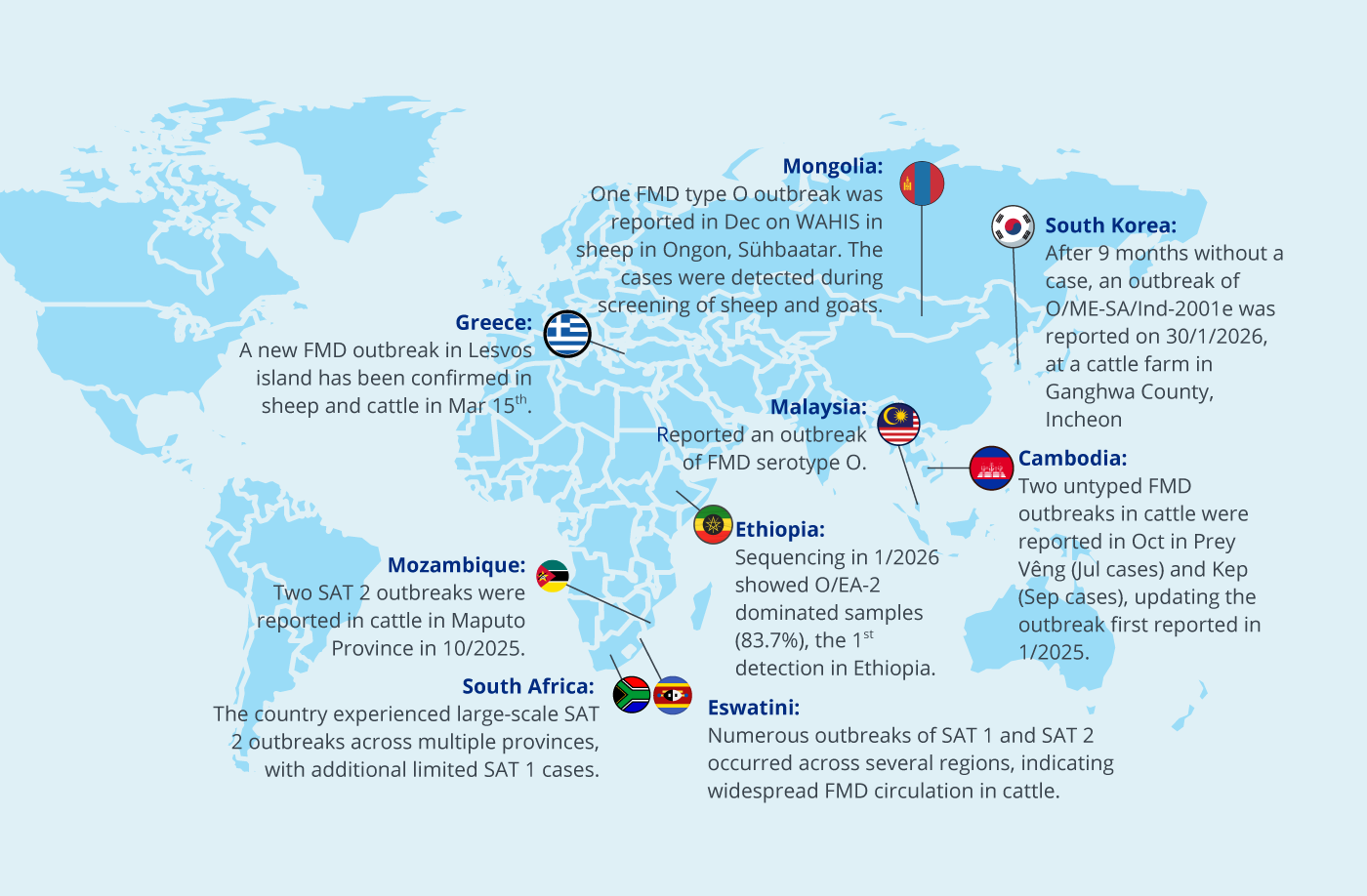
Asia is divided into two WOAH endemic pools: Pool 1 (Southeast, East, and Central Asia) and Pool 2 (South Asia), where FMD serotypes O, A, and Asia 1 continue to circulate.
In Pool 1, FMD remains endemic, with outbreaks reported in Cambodia, China, Indonesia, and Mongolia during Oct–Dec 2025. Serotype O was confirmed in China and Mongolia, while cases in Cambodia and Indonesia were untyped; the O/ME-SA/Ind-2001 lineage continues to dominate.
In Pool 2, India and Bangladesh reported outbreaks, with O/ME-SA/SA-2018 as the predominant lineage, followed by O/ME-SA/Ind-2001 and A/ASIA/G-VII.
Overall, serotype O remains dominant across Asia, with Ind-2001 prevalent in Pool 1 and SA-2018 dominant in Pool 2.
Source: WOAH-FAO FMD Ref Lab Report Oct - Dec 2025; WAHIS
During Q4 2025, the global FMD situation remained dynamic, with multiple serotypes circulating across endemic regions. Serotype O dominated in Asia, while SAT1 and SAT2 were prevalent in the Middle East and Africa. Although Europe and South America remained largely free of outbreaks, both regions continue to face a risk of virus incursions from neighboring endemic areas.
Notably, FMD serotype SAT1 expanded across West Eurasia, raising concerns for countries with low herd immunity. After its first detection in Iraq in April 2025, the virus spread to Kuwait, Türkiye, Egypt, Azerbaijan, and northern Cyprus by late 2025. Genetic analyses in late 2025–early 2026 also identified the SAT1/III lineage in Iran and Türkiye, with additional detections in Azerbaijan and Lebanon, highlighting continued regional spread and the need for strengthened surveillance and vaccination preparedness.
Pool 3 experienced dynamic FMD activity, mainly driven by the spread of SAT 1 (topotype I) from East Africa. Cases were confirmed in Türkiye, Iran, Egypt, Azerbaijan, and Cyprus, and extensive vaccination programs were implemented to control the risk.
Europe remained largely FMD-free, although a SAT 1 outbreak in northern Cyprus (December 2025) and a new outbreak in Greece affecting sheep and cattle (March 2026) highlight the ongoing risk of incursions from neighboring endemic regions.
North and Eastern Africa: This area remains a source of trans-regional risk, evidenced by exotic SAT 1/I incursions into Egypt and the first-ever detection of the O/EA-2 topotype in Ethiopia.
West/Central Africa: Serotypes O, A, SAT 1, and SAT 2 are present in the region, with Nigeria reporting an outbreak of untyped FMD in cattle during this period.
Southern Africa: Significant disease pressure continues in the region, highlighted by 260 SAT 2 outbreaks in South Africa and the co-circulation of SAT 1 and SAT 2 in Eswatini.
No new outbreaks of foot-and-mouth disease were reported in South America.
Source: WOAH-FAO FMD Ref Lab Report Oct - Dec 2025; WAHIS
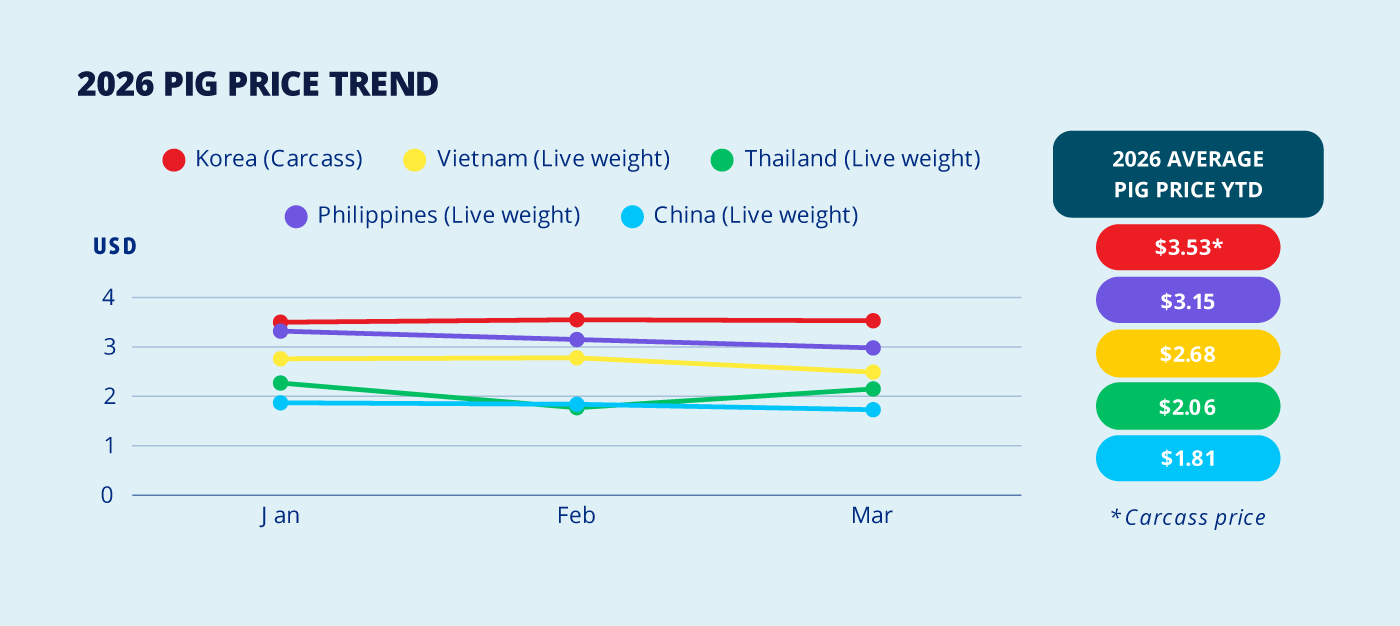
Pork Markets across Asia show mixed conditions: low prices due to oversupply in China and Thailand; high prices due to strong demand but constrained supply in Vietnam and the Philippines; and stable prices due to flat demand and balanced supply in Japan, South Korea and Taiwan.
Pig producers across the region are pursuing cautious expansion due to continued disease threats, trade restrictions and rising construction costs. Thriving in swine production will require farms to focus on efficient production, strong biosecurity and the effective use of technology.
LIVESTOCK NEWS
China faces pork price pressure due to oversupply:
China’s pork supply remains abundant while consumer demand is relatively weak, resulting in low pork prices. Producers are reducing sow herd and focusing on productivity and efficiency to stabilize supply and restore profitability. Chinese sow herd are expected to decline to 39 million heads in 2026.
Thailand sees a pork price drop, as supply outspaces stable demand:
Thailand’s pork price drop in early 2026 is mainly driven by oversupply following herd recovery, while domestic demand remain stable. Producers are rebuilding cautiously while strenghtening farm biosecurity and improving productivity to stabilize supply and support price recovery.
Vietnam benefits from seasonal demand and higher prices amid constrained pork supply:
Pork demand remains strong, especially during the Tet holidays. Disease pressures, mainly from ASF, and severe flooding in Central Vietnam have reduced the pig herd. Small producers exit production due to high disease risks, while large-scale farms expand market share, adopting better biosecurity and modern farm systems to rebuild safely.
Philippines continues to face limited pork supply and high prices:
Pork supply remains constrained as ASF continues to slow herd recovery. Tight supply has supported pork prices, while imports continue to fill the supply gap. Imports are expected to continuously increase in 2026. Authorities are testing and gradually deploying ASF vaccines to support herd rebuilding.
South Korea maintains balanced pork supply and demand:
South Korea’s pork market remains stable, supported by steady demand but producers continue to face high feed and production costs. Producers are expected to maintain cautious production levels while strengthening biosecurity to mitigate ASF risks. Imports will likely remain important to balance supply and stabilize the market.
Japan has stable pork supply with slow demand growth:
Pork demand remains relatively flat, while domestic supply is stable, keeping prices steady. Imports continue to play an important role in meeting consumption needs and maintaining market balance. The industry continue to focus on efficiency, productivity and product quality while ensuring a relying both from domestic production and imports.
Taiwan’s pork market remains stable, supported by strong biosecurity and ASF-free status:
Taiwan’s pork market is relatively balanced because most pork is consumed domestically. It has remained ASF-free which supports stable production and industry confidence. It has regained export market access to Philippines and other markets, creating potential growth opportunities.
Source: Compiled and summarized by Biogénesis Bagó Asia
Biogénesis Bagó, in partnership with the Paraná Institute of Technology (TECPAR), has been selected to supply antigens and vaccines for Brazil’s first National FMD Vaccine Bank. This strategic initiative strengthens Brazil’s preparedness to respond rapidly to potential outbreaks in the world’s leading beef-producing country.

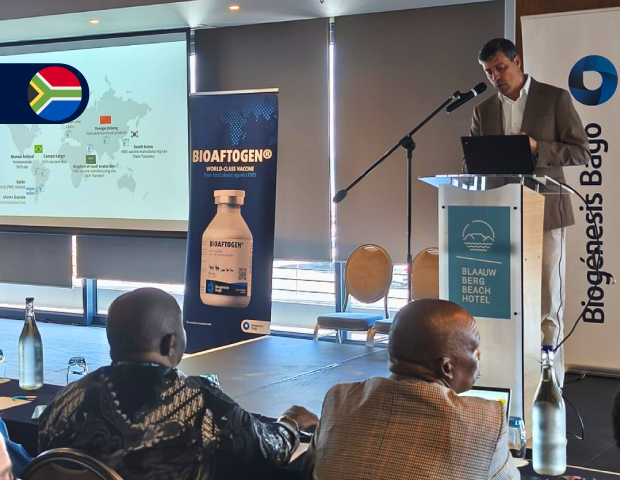
Biogénesis Bagó was selected by South Africa as a strategic partner to support the national response to the recent FMD emergency.
The company provided high-potency SAT vaccines (SAT 1, SAT 2 & SAT 3) to support rapid outbreak containment as part of the country’s national control strategy.
The first vaccine shipments were supplied between January and March 2026, reinforcing Biogénesis Bagó’s role as a trusted global partner for rapid, large-scale FMD emergency response.
Biogénesis Bagó, a Global Leader in FMD Prevention
Biogénesis Bagó is a global biotechnology company recognized for its leadership in the prevention and control of foot-and-mouth disease (FMD). With more than 70 years of experience, the company has developed strong capabilities in FMD vaccine research, antigen production, and large-scale manufacturing, supported by advanced biosafety facilities and strict international quality standards.
Its BIOAFTOGEN® vaccine portfolio offers broad antigenic coverage against multiple FMD serotypes and strains circulating worldwide.
Through continuous global strain monitoring, collaboration with veterinary authorities, and participation in international antigen banks, Biogénesis Bagó actively contributes to national and regional strategies aimed at the effective control and long-term eradication of FMD.
Proven global success stories in FMD control programs include: